
Mulch mounds kill trees
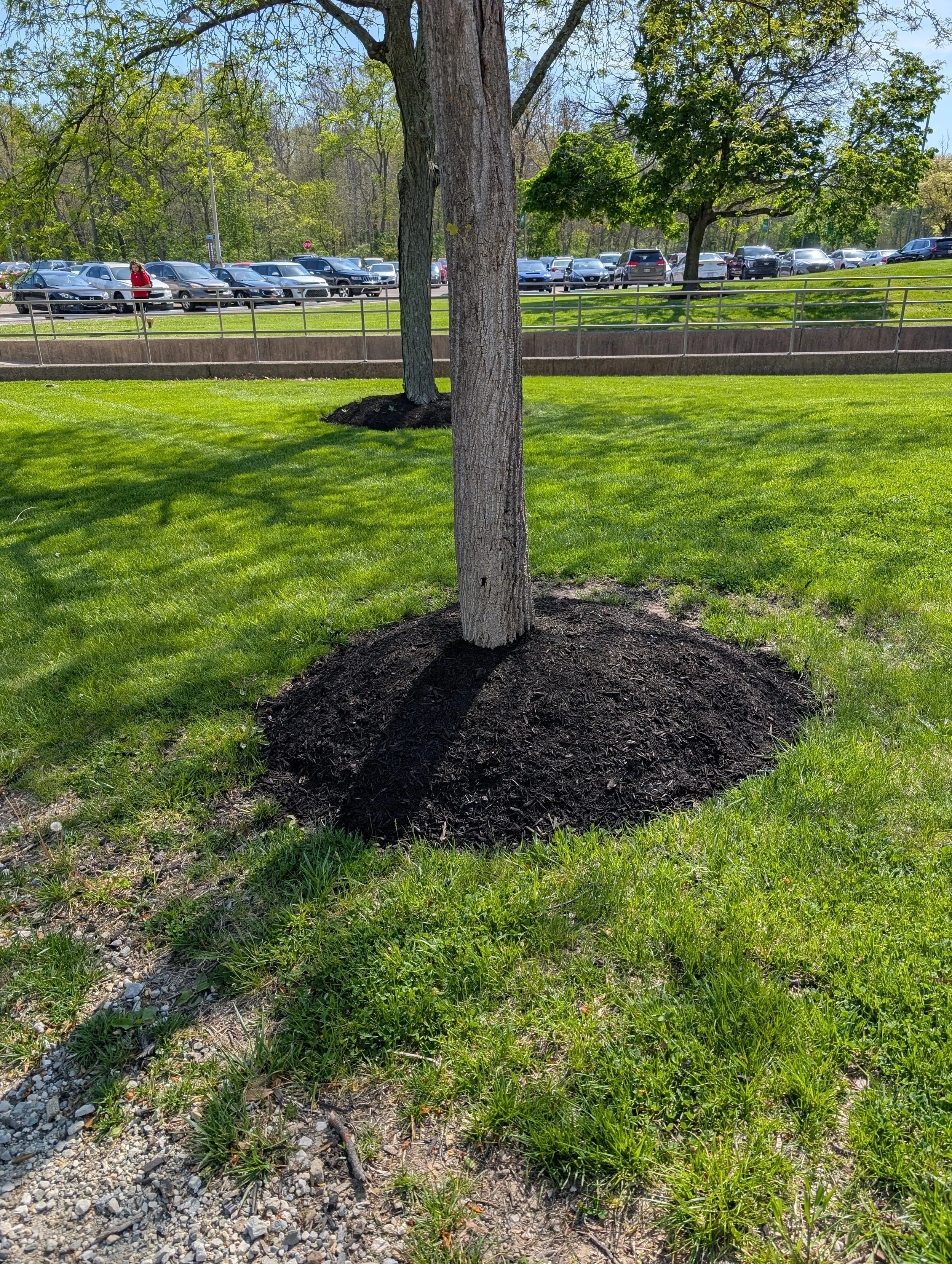
Mulch mound on a university campus, April 2026.
Spring time is here. And that means our least favorite animal has started to appear - mulch mounds. This animal shows up everywhere - college campuses (like the photo above), street trees, grocery store parking lots, and worst of all - your own backyard. But with a little knowledge and care, you can prevent this beast from killing your trees.
Why are mulch mounds bad for trees?
Trees have a distinct root collar where the stem and root system connect to one another. The massive root system of a tree is meant to have soil around it - the roots are pulling water and nutrients from the soil up into the vascular system and all through the different tissues of the tree. Above the roots, though, these systems change. While tree stems do still partake in some gas and water exchange, their primary purpose is in stability and support. So stems are simply not meant to be surrounded by soil because they are not pulling in moisture and nutrients to send through the rest of the tree.
Because the stem is not meant to be covered by soil or mulch, when it is packed up against this area of a tree, a few things happen:
While a tree’s root system is built for absorbing large amounts of water and nutrients, the stem is not. Because the tree is unable to absorb these extra ingredients, moisture builds up against the bark of the tree which creates prime habitat for fungi and bacteria, both of which can cause decay.
When the root collar begins to decay, trees are less able to send sugars down to the root system, causing root decline and severely impacting the stability of the entire root system.
Roots grow in relation to the surrounding soil and organic matter. When that soil and organic matter is too high, the roots don’t know to grow deep and can stay too shallow to successfully reach water and nutrients during times of drought or stress, meaning the tree will be less resilience to these issues.
If trees are planted this way when they are young, they also risk experiencing girdling roots which is when roots grow around themselves, essentially strangling themselves over time.
What are symptoms of root collar issues?
Many times trees that have had years of mulch mounds will start to show some classic symptoms. It’s important to note that many of these symptoms are general symptoms of tree stress. And at the same time, stress signs in trees can be somewhat species specific, so not all trees show these symptoms in the same way at the same time.
Canopy is fading from the top-down. Because the top of the tree is the farthest distance for water and nutrients to travel from the roots, it’s the first place that is cut off when these resources are limited. When trees are experiencing root and root collar disorders, you will often see a thinning crown that is worse at the very top of the tree.
Epicormic shoots from dormant buds are another sign of stress. When the crown begins to fade, often times you’ll see new growth in places where it isn’t meant to be. These dormant buds are there for emergency situations so, when you see foliage or new branches growing from the base of the tree, the stem, or in branch crotches, this means the tree is very stressed out.
The last sign of root collar stress unfortunately happens when it’s too late - snapping of the tree at its base. When trees experience decay at the root collar, have an inability to send water and nutrients throughout the tree, and have exhausted their reserves in the form of epicormic sprouts, the connection between the stem and the roots is greatly reduced. This is when we see snapped trees where the root system stays in the ground, especially during severe storms.
So what can I do about this?
The first step is to monitor any landscaping work being done on your property and insist that they create a mulch donut instead of a mulch mound. This mulch donut will dip towards the base of the tree which retains moisture above the roots but does not cause decay.
If your tree is already experiencing some of these symptoms, it’s not too late! It is possible to remove the mulch mound, excavate the root system, and even remove girdling roots to let your trees take a deep breath. The earlier you catch it, the better!
Schedule your call with ecoLogic to get a tree health assessment and take the first steps towards improving the health of your trees.